Wine by Rail: A Day on the Franschhoek Wine Tram
The Franschhoek Wine Tram is one of those days that reminds you why you travel. Good wine, unexpected moments, and a valley that has been doing this for over three hundred years.
Elaine Brackin
3/20/20264 min read
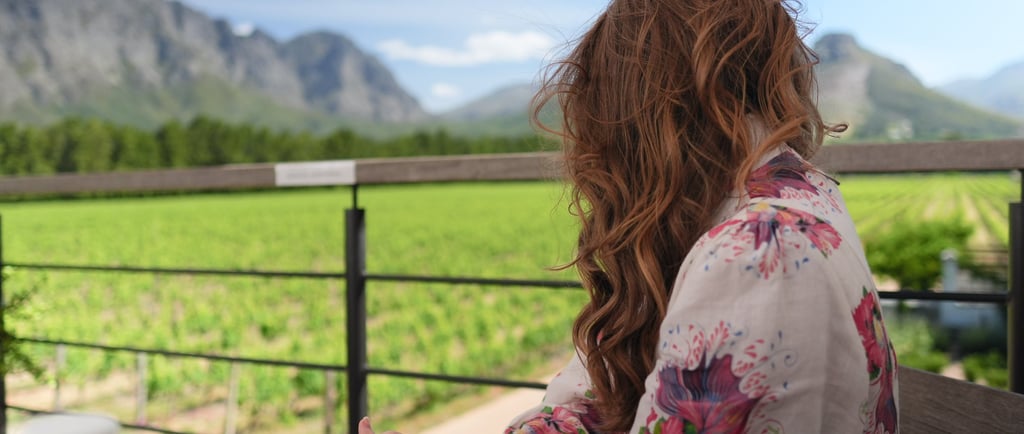
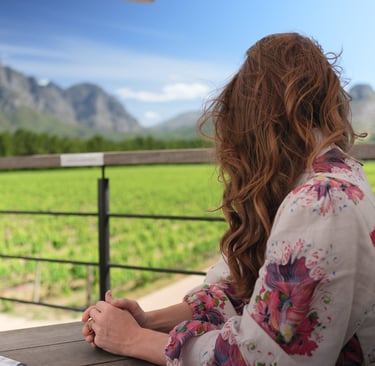
They hand you a glass of wine before the tram even moves.
In a plastic champagne flute, no less. You are standing at the ticket office on Huguenot Road, named for the French Protestant refugees who fled here in 1688 carrying little more than their faith and their knowledge of grapes, and a young man with an easy manner is explaining the day. The Blue Line. Eight estates. Tractor rides, in certain places, to reach the platforms. A loop that ends back in the village by five o'clock. And in your hand, this cheerful plastic flute, because the wine is not waiting for anyone to find a proper glass.
We are on the upper deck, front row, which requires the kind of quiet determination that seasoned travelers understand. The young man working the tram notices the gimbal, asks what we are filming for. We tell him: Passport Dates, our YouTube channel. He pulls out his phone and subscribes on the spot.
The tram moves at a solid clip. Vineyards and mountain faces and old Cape Dutch gables pass like frames from a film you didn't know you needed to see.
Franschhoek means French Corner in Dutch. The Huguenots arrived here over three hundred years ago, refugees who had hidden their Bibles in loaves of bread to smuggle them across borders. They planted vines. They named their farms La Bri and Grande Provence and La Bourgogne, homesick words pressed into foreign soil. The mountains that enclosed them then still enclose us now. The tram runs on a branch line built in 1904. You feel the age of it pleasantly, the way you feel the age of a good dining table. Not fragile. Settled.
At Rickety Bridge, a small tractor collects you from the platform and bumps you through the vines to the estate. We share it with a couple who have been following the same instincts as us all morning: a glass here, a longer pause there. By the time we arrive we have been through three wineries together without ever formally introducing ourselves. Travel does this.
We stay at Rickety Bridge for a long time.
The Chardonnay arrives first, bright and mineral, with a finish that makes you sit up and reconsider the glass. My husband takes one sip and doesn't put it down again for the rest of lunch. The food comes in the unhurried way of a kitchen that understands its job. We eat well. We order more than we need. We do not apologize for this.
And then the lokum.
It arrives on a slate beside a Pinotage tasting, small jewel-colored cubes catching the light. We see it on the menu and my husband's reaction gives us away. The sommelier puts it together quickly. The lokum is made by a Turkish woman, she tells us, and she wants us to try it.
Pinotage is South Africa's grape, created in 1925 when viticulturist Abraham Izak Perold crossed Pinot Noir and Cinsaut. The result belonged to neither parent country but was entirely itself. Smoky, earthy, dark with plum and coffee. A child of migrants that became something new.
My husband looks at me. I look at him.
He was raised on lokum the way other children are raised on boiled sweets, the taste that means home, his grandmother's tin on the kitchen shelf in Istanbul. He has never expected to encounter it in the Western Cape. He tasted it. He gave me a look, just the private look of a man who has been seen in a place far from where he expected to be seen. A little proud. A little moved.
The geography of the world, in that moment, folded.
Grande Provence was founded in 1694, which means it has been making wine here since before the French Revolution. You walk through the sculpture garden and the history settles on you quietly, without insisting on itself. We ate oysters on the lawn with a glass of their MCC, Méthode Cap Classique, the South African answer to Champagne, and watched the mountains not move, which is what mountains do best.
The couple from the tractor found us here. Of course they did. We raised our glasses at them across the garden. They raised theirs back. No words needed.
We are not sommeliers. We don't speak in paragraphs about tannins. But we know what stops us mid-sip, and near the end of the day we found ourselves sharing two full flights of vintage wines the way we share most things: passing the glass, raising an eyebrow, nodding at each other in the way that means yes, that one. We drank what we liked. We liked quite a lot of it.
Our guesthouse was five minutes on foot. We had planned this very deliberately.
No car to locate. No transfer to arrange. Just the main street, the evening light coming in low and gold, my husband slightly ahead of me the way he gets when he's content, the mountains still exactly where we'd left them that morning.
Here is the truth about the Franschhoek Wine Tram: it is not really about wine. It is about moving through a beautiful place with no obligation other than to notice things. The young man who subscribed on the spot. The couple who became companions without exchanging surnames. The tractor through the vines. The lokum that crossed three continents to find us at a slate table in the Western Cape.
We have been a lot of places. We have rarely felt more like we were exactly where we were supposed to be.
If you go: The Blue Line stops at Grande Provence, Rickety Bridge, La Bri, Holden Manz, and several others, running on an original 1904 branch line. Book ahead, and book lunch at Rickety Bridge separately. Give yourself the full afternoon and don't rush it. At La Bri, do not skip the tasting pairings: they offer the Pinotage with lokum, with chocolate, and with biltong. We did the wine and lokum and the wine and chocolate both. No regrets. Stay in the village if you can. Talk to the people who work the tram. They know things the itinerary doesn't say.
One note: the estates on each line can change, so check closer to your date in case something on your list has moved. It is worth confirming before you go.
Planning a trip to the Cape Winelands? We design itineraries that give you days like this one. Write to us at [email] and let's start talking.
"Your passport tells a story. Let the world be your ink." — Passport Dates