Why Some Trips Stay With You Forever (And Others Don't)
There's a neurological reason why some travel memories feel permanent while others vanish within weeks. Elaine Brackin of Passport Dates explores the science behind why intentional travel creates the memories that last a lifetime.
Elaine Brackin
6/26/20264 min read
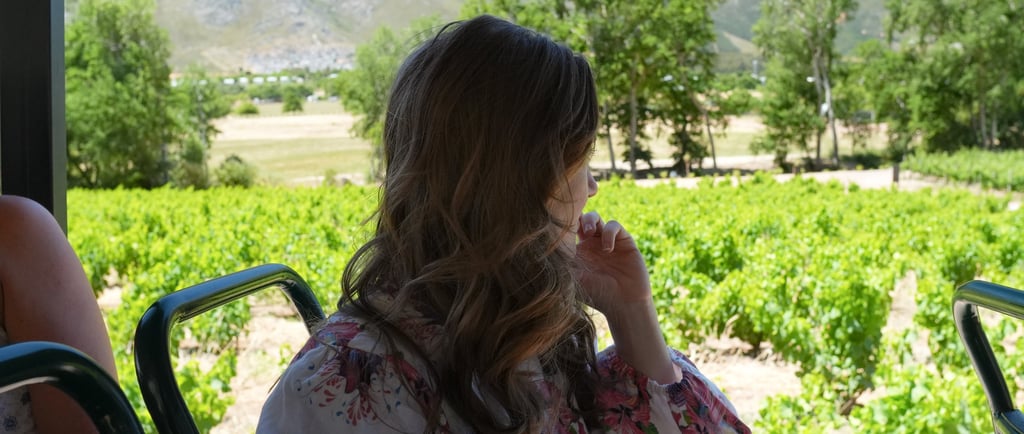

I can still smell the pinotage.
The wine tram, the valley opening up on both sides. Then a cafe that could have been in France, a glass of pinotage, a breeze through an open window. Some trips you carry. This one I still do.
And then there are trips I can barely reconstruct. Nice hotels. Good food. Nothing wrong with any of it. Just gone.
For a long time I thought this was random. It isn't.
What Neuroscience Has Found
A neuroscientist named Paul Zak at Claremont Graduate University wanted to know what stories actually do to us, not in theory, but in blood. So he drew it. From real people, listening to real stories, in real time.
What he found was a sequence. Tension and uncertainty trigger cortisol, the stress hormone that tells your brain to pay attention. Genuine empathy releases oxytocin, sometimes called the "moral molecule," the one that makes you feel connected and open and like you trust what's happening. A satisfying ending releases dopamine. (Zak, Claremont Graduate University)
Three chemicals. In that order. Every time a good story works, that's what's happening inside you.
Uri Hasson at Princeton went further. He put storytellers and listeners in fMRI machines and watched their brain activity in real time. What he found was almost disorienting: when a story lands, the listener's brain starts to mirror the speaker's, processing the same emotions, the same sensory information, in remarkably similar patterns. The brain, it turns out, doesn't draw a clean line between experiencing something and hearing it described well. (Hasson et al., PNAS, 2010)
Which means when someone tells you about a trip that moved them, something close to the experience actually happens to you. Not a metaphor. Biology.
Why Some Moments Stick
There's a second piece to this, and it's simpler.
Research published in Trends in Neurosciences found that when you encounter something genuinely new, something your brain has no real category for, it releases dopamine in the hippocampus, the part of the brain responsible for memory. That dopamine hit is what tags an experience as worth keeping. Without it, memories don't consolidate. They dissolve within four to six hours. (Trends in Neurosciences, 2019)
The researchers found that not all novelty is equal. Something new that still resembles things you've done before creates a mild response. Something completely outside your experience, a different culture, a different landscape, a different way of moving through the world, creates a much stronger one. Those are the memories that stay specific and sensory for years. The ones you can still smell.
This is why a week at a resort you've been to before, however lovely, rarely produces the same effect as a week somewhere that genuinely surprises you. It's not snobbery. It's neuroscience.
The 20-Minute Rule I Keep Breaking
We were in Kathmandu, at Pashupatinath, the cremation temple on the banks of the Bagmati River. I said, as I always say: "Let's give it twenty minutes."
We stayed four hours.
There was something happening there that we didn't have language for yet. Families gathered on the ghats. Smoke rising. A kind of grief that was entirely public, entirely ordinary, and entirely unlike anything we had witnessed before. We stood and watched and didn't speak much and didn't want to leave. The brain, it turns out, was doing exactly what the research describes: registering something so outside its existing categories that it committed the whole afternoon to memory.
That same trip, at breakfast in the courtyard at Dwarika's, one of Kathmandu's great heritage hotels, I noticed an older gentleman at a nearby table. He was dressed entirely in shades of yellow and had what looked like a writing satchel beside his chair. I said to my husband: "I bet he has a story." When we returned that evening, he stopped us and invited us to dinner. We had to say no. We were already committed elsewhere.
I still think about that. The dinner we didn't have. The story we didn't hear. It's one of the few travel regrets I carry, which tells you something about what the brain does with unresolved questions. It holds them. It keeps returning. It wants the loop closed.
When Travel Is a Gift
When you give someone a genuinely novel experience, you are not giving them a few days away. You are giving them a story. And according to Hasson's research, every time they tell that story, the listener's brain begins to mirror theirs. The experience travels with them. It multiplies. It gets told at dinner tables and to children and to friends who weren't there, and each time, something close to the original experience is recreated in the people who hear it.
A trip designed with intention doesn't end when you come home. It keeps going.
There's something else here worth saying, and I'll write more on it in a separate piece: the delivery matters too. Telling someone "we're going to Hawaii" doesn't hit the same as letting the story develop, building anticipation, letting them feel the trip before it begins. The brain responds to narrative, not announcements. How you give the gift is part of the gift.
What This Has to Do With How We Travel
We design trips around this. What we've found is that the experiences people remember most vividly are rarely the most expensive. They're the ones where something landed. The afternoon that went off-script. The moment no one planned, in a place that was actually foreign to them. The dinner they almost didn't accept.
What stays is distinct: the cremation temple, that afternoon in Franschhoek, the old man at breakfast whose name we never learned.The trips worth designing are the ones the brain decides to keep.