What We Used Instead of a Drone in Egypt (And Why It Worked Better)
Drones are banned throughout Egypt. Here is how we captured Karnak, the Valley of the Kings, a felucca on the Nile, and horseback through Luxor with an Insta360 X4, and why we do not miss the drone at all.
Elaine Brackin
3/24/20264 min read
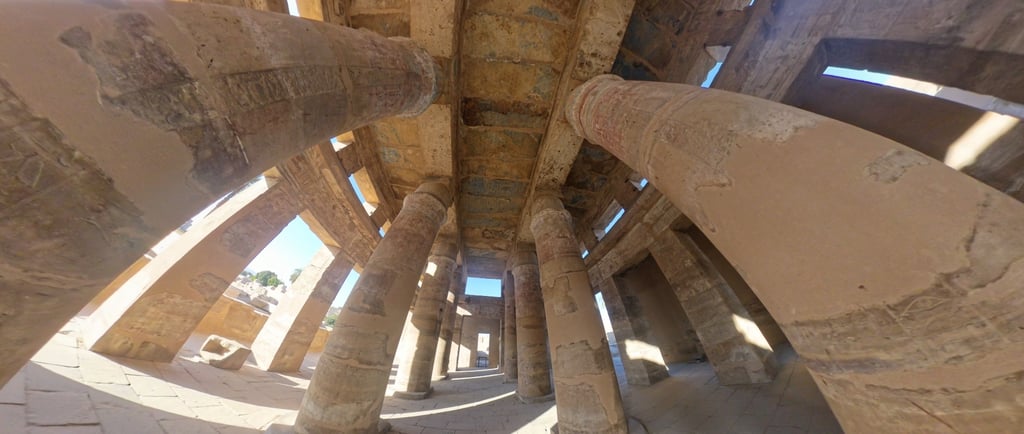
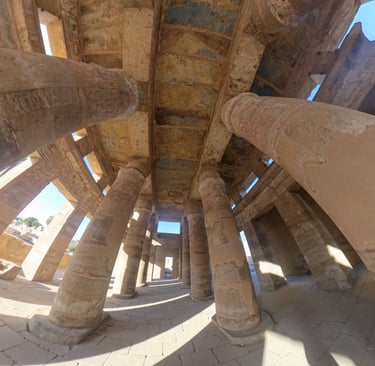
We knew before we left. Drones are banned throughout Egypt, not just at the temples, not just in Luxor. The law has been in effect since 2017 and it covers the entire country. No tourist permits, no exceptions. Anything you bring in gets confiscated and does not come back.
So we left the drone at home. What we did not plan to leave behind was the Insta360 stick and our tripod. Two back-to-back trips, a packing rush, and suddenly we were in Egypt with the camera and nothing to mount it on.
We improvised. The bottom of our gimbal screws onto the Insta360 just fine, so we used that when we needed a base. The rest of the time we carried it at chest level, which does mean you lose the back angle (bc it is your awkward face or chest close-up), but you keep more than you would expect, and the stabilization handles the movement. It is not the setup we would have chosen. It worked anyway.
That turned out to be the best mistake we made.
The Airport, Two Camera Bags, and a Very Stern Officer
We landed with two camera bags between us. In a crowd of hundreds, a security officer stopped us. His expression was not warm.
Do you have a drone?
We said no. We meant it.
He looked at us for a long moment, the kind that makes you mentally inventory everything you packed, and then something shifted. He smiled. I trust you, he said, and waved us through.
That moment set the tone for the whole trip. Security in Luxor is layered. There are checkpoints at airports, at ticket offices, at temple entrances. We were stopped more than once. Occasionally someone would look at our gear and suggest, with some authority, that we looked too professional and would need to pay an additional fee. We had done enough research to recognize that for what it was. We held our ground. Each time, another officer would appear and tell the person to leave us alone.
We were not the only ones with a 360 camera. We were not even the ones with the most impressive gear. But we did have at least three people ask if we were filming a series, so perhaps we did look slightly more production than tourist. We took it as a compliment and kept walking.
What the Insta360 X4 Captured That a Drone Never Could
Here is the thing about drones in a place like Karnak or the Valley of the Kings: they would have shown you the scale from above. The Insta360 showed us the scale from inside it.
Walking through corridors of columns that have been standing for three thousand years, the camera small enough to carry in one hand with no stick. Going underground into the tombs in the Valley of the Kings, where the paintings are close enough to touch and the ceiling presses low. A drone cannot go there. Nothing flies in a tomb. But the Insta360 moved with us through every passageway, capturing the full surround without us having to choose an angle or worry about missing something.
That is the particular gift of a 360 camera in a place that overwhelms the eye. You stop trying to frame everything perfectly. You just move through it, and the camera catches what you cannot.
There is also the matter of the camera men.
In Luxor, there are locals who will take your camera and photograph you. For a tip. It happens constantly, and at first we resisted entirely because the whole arrangement felt like the kind of pressure we prefer to sidestep. We only allowed it once: inside a tomb, where a man had been photographing other visitors and the situation felt genuinely harmless. The photos were good, actually. But we did not do it again. It is one of those small negotiations that travel asks of you, and we made our choice.
Beyond Egypt: Why We Bring This Camera Everywhere Now
On the same trip, we took the Insta360 on a felucca on the Nile. The boat moving, the light changing, the water catching everything, and us not scrambling to point a camera in the right direction. It just captured it. We could focus on b-roll, or just... enjoying the moment.
On horseback through the countryside outside Luxor, same thing. Footage that moves the way riding actually feels: fluid, a little unpredictable, fully alive. Very difficult with a full-size camera.
Later, in Kruger National Park in South Africa, we used it at a swimming hole and on game drives. Animals do not care about your camera equipment, but a drone would have sent every one of them running, and gotten us a hefty fine. The Insta360 sits in your hand or on a surface and disappears into the moment.
That is what we keep coming back to. There is so much going on in places like these. The 360 camera means we are not spending the experience chasing angles. We are just there, and it handles the rest.
Insta360 X4 vs X5: Which One Do We Use?
There is now an Insta360 X5 available. We have looked at it. For what we do, the X4 still gives us everything we need: the image quality, the stabilization, the ease of use in unpredictable conditions. If you are starting fresh and want the latest features, the X5 is worth considering. But we have no reason to move on from the X4, and we have now used it across two continents and more situations than we planned for.
Including an Egyptian airport security line with two camera bags and a very skeptical officer.
He trusted us. We brought the right camera. That is about as good as travel planning gets.
We use and recommend the Insta360 X4. The Insta360 X5 is the newest model if you want the latest specs. Either way, if you are traveling to Egypt or anywhere with drone restrictions, a 360 camera is the move. No airspace needed, no confiscation risk, and it fits in a coat pocket.
Some of the links we share may be affiliate links, which means we may earn a small commission if you make a purchase through them, at no additional cost to you. We only recommend gear we genuinely use and trust.