What Pashupatinath Taught Me About Being Alive
We ended up staying until after dark, watching families carry their dead to the river, a son light his father's pyre, and thousands of strangers gather for a ceremony we hadn't known was coming. This is what happens when you let a place actually reach you.
Elaine Brackin
6/9/20268 min read
What Pashupatinath Taught Me About Being Alive
We were supposed to stay twenty minutes.
The day had been running since morning. We had done a shoot on property at The Dwarika's before the sun got too high, then made the half-hour drive out through the valley to Bhaktapur, the medieval city that sits at the edge of Kathmandu like a page torn from another century. We had spent a couple of hours there, in the dust and the courtyards and the heat, the kind of wandering that fills you up and empties you out at the same time. We had a tailor appointment at five o'clock for a suit we had commissioned, and we had already pushed it once.
We went back to the hotel, dropped our things, and got back into the same taxi. Five minutes through the kind of traffic that only Kathmandu knows how to produce. And then we were there, at the gates of Pashupatinath Temple, with no plan beyond a quick look.
The entry fee for foreign visitors is 1,000 Nepalese rupees, roughly eight dollars. It may be the most significant eight dollars I have ever spent.
What hit me first was not the smoke, and it was not the sound. It was a weight in the air that I did not have a word for and still don't, entirely. The feeling of a place that has been holding something enormous for a very long time. The kind of presence you sense in certain old buildings or deep forests, where the atmosphere itself seems to carry memory.
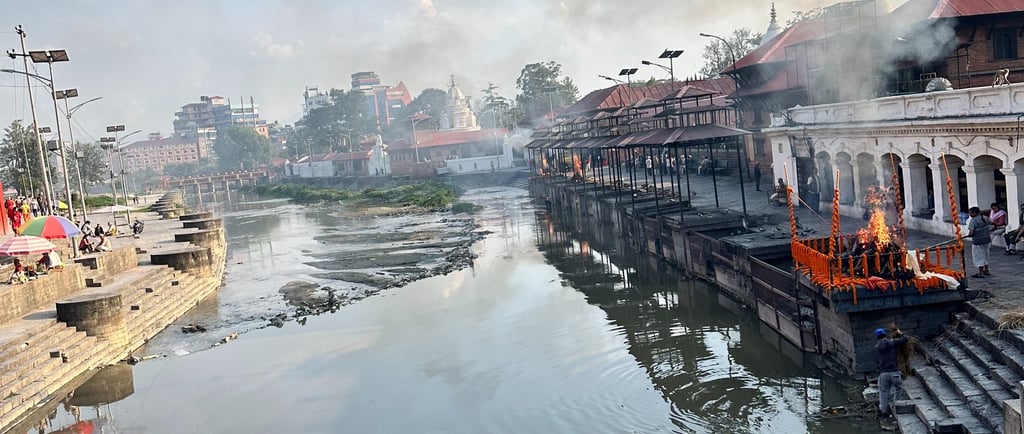
We are not permitted inside the main temple as tourists. That is as it should be. What we had access to was the complex along the Bagmati River, the ghats, the grounds, and everything that was happening on them.
And what was happening was this: people were burning their dead.
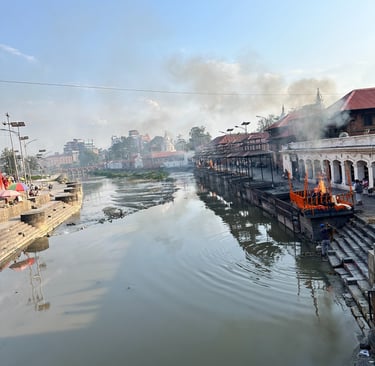
Three pyres when we arrived. Three more being laid. The smoke was pale and slow and moved across the river in the afternoon light. The smell was sandalwood, incense, ghee, butter. It did not smell like what I would have expected. It did not smell like death, the way we understand death in the West, which is to say the way we try not to smell it at all. It smelled, if I am honest, like ceremony. Like something intentional and old.
A man attached himself to us almost immediately, explaining everything in a steady stream. He seemed to be affiliated with the grounds. I was grateful and overwhelmed, taking in information faster than I could actually hold it. Because I was still absorbing what my eyes were telling me.
Then a man with a long stick stepped forward and moved the wood on the nearest pyre, and the hay shifted, and I saw the charred outline of a skeleton.
That was the moment it became real.
I had known, walking in. I had known what this place was. I had filed the fact away the way you file things when you are building an itinerary and you are thinking about logistics rather than what it will actually feel like to stand somewhere. But there is a distance between knowing and seeing, and in the space between them, something cracked open.
One of the pyres was directly in front of us. Not across the river, not at a viewing distance. Right there.
Behind us, stretched out on the warm stone steps, approximately twenty stray dogs were sleeping and playing and completely at home. This is their territory as much as anyone's. They have always been here. They will be here long after the tourists go.
On the opposite bank, rows of people sat watching. Some were pilgrims. Some were visitors like us. It felt strange to be among them, strange to have a camera, strange that this most private human experience was also, technically, something you could buy a ticket to see. I kept returning to that strangeness and not being able to resolve it. And then I noticed that the families on the ghats seemed entirely unbothered by our presence. Death here is not hidden. It does not need protection from strangers. It is simply part of what happens, treated with all the ceremony and love it deserves.
While we were there, three more bodies arrived.
One family brought their man to the water before the pyre. He was wrapped in white cloth. They laid him at the river's edge and the family waded in, some just to the ankles, some deeper, some fully under. They washed him. His wife bent over his body and pressed her head to his chest, and there is nothing to say about that moment except that I watched it and felt it land somewhere I will not entirely recover from.
The guide explained things as we stood there. He told us that bodies here are brought within hours of death, not the days that Western mortuary culture requires. He told us that when a mother dies, her children abstain from milk during the mourning period, because she was the source of it. When a father dies, the restriction is different. These details, these specific, embodied ways of marking what has been lost, stopped me entirely. Grief given a physical shape. Loss made into something you do with your body, not just feel in your chest.
The wood that burns on these pyres is sandalwood. The same sandalwood that I had smelled an hour earlier, in the lobby of The Dwarika's. I did not put that together until later. When I did, I sat with it for a while.
The eldest son is the one who lights his father's pyre. He places the flame at the mouth, where Hindus believe the soul departs the body. He and his brothers walked around three times before the fire was set. There are some things no one needs to tell you not to film. This was one of them.
I want to be careful here, because I am not Hindu and I do not want to speak about a belief system as though I understand it from the inside. What I can tell you is what I was told and what I felt, held loosely, with the humility of a witness.
Hindus believe that being cremated on the banks of the Bagmati River, which flows into the Ganges, brings the soul toward moksha, liberation from the cycle of birth and rebirth. Death here is not a tragedy in the way I was raised to understand tragedy. It is a transition. The flames do not destroy. They release. My own family believes in an afterlife too, but not quite like this. Not with this quality of matter-of-factness, this integration of death into the middle of the living day, the cattle and the dogs and the marigolds and the smoke all present at once.
There is something in that which I am still working out.
We kept saying we should leave. We had the tailor. We had already pushed the appointment once.
We did not leave.
Around dusk, the crowd multiplied in a way that was hard to believe. People flooded in from every direction. We later learned that entry becomes free after a certain hour, and the Sandhya Aarti, the evening ceremony, was beginning. In spring, it starts around seven. Priests appeared along the riverbank. A man moved through the grounds lighting ceremonial fires. A small boy, no more than six, followed behind him and quietly, sneakily, put one out. No one laughed. No one saw but us.
The crowd swelled to the thousands. We had arrived when there were almost no visitors and watched the space transform into something that felt like a city unto itself.
We finally left when we truly had to. The tailor was waiting. It was a whole other adventure, the kind that kept us out until well past nine and then somehow until two in the morning, with a five o'clock airport call the next day. Kathmandu was not finished with us.
As we walked out along the other side of the complex, my husband pointed and I looked. Tucked into the stone arches beneath the upper ghats, small groups of people sat in alcoves, watching the fires that were carrying their people away. Quiet. Together. Staying until it was finished.
I thought: this is what it looks like when a culture does not look away.
It has been more than a week since we left Nepal and I think about Pashupatinath every day. Not dramatically. The way you think about something that has rearranged something small but permanent inside you. It gave me a new relationship to the fact that I am alive. To the people I love being alive. To the ordinary Tuesday of it.
That is worth more than any photograph.
The Dwarika's
We came back to the hotel that evening in a state of complete sensory overload, which is the precise state The Dwarika's is built for, even if it doesn't know it.
The smell hit us first, walking through the door. Sandalwood. The same wood. The driver opened the car door and we could see straight into the lobby, the large traditional vessel just inside the entrance, fresh flowers floating at the surface, the carved dark wood of the courtyard beyond. Every piece of this hotel was salvaged from temples and historic buildings across the valley that might otherwise have been lost. Walking in is not like checking into a hotel. It is like being absorbed by something that has decided to take care of you.
In the sitting area near the entrance, each table had a traditional Nepali game on it. We walked past them. We were not ready for games. We sat somewhere quiet, and the hotel left us alone, and that was exactly right.
After the afternoon we'd had, we didn't eat there that night. We went to the tailor. But I want to tell you about The Dwarika's because if you go to Kathmandu, this is where you should stay, and if you book through us, here is what that means in practice.
Booking with Passport Dates
We are Passport Dates, and when you book through us, you have actual people behind your trip. For The Dwarika's among thousands of other partners, we can arrange room upgrades, breakfast, and more. We can organize private guides, recommend the ones worth trusting, and who are reachable when the day goes sideways in the best possible way.
A trip that gets under your skin like this one did doesn't happen by accident. It happens because someone helped you build it right. Reach out and let's talk.
For tours and local experiences around Kathmandu and the temple complex, GetYourGuide and Viator both have strong local operators.
Getting there on points
We used Capital One miles transferred to Turkish Airlines for the main flight, and United miles for another leg. If you're not yet accumulating travel points, both the Capital One Venture card and the United Explorer card are worth looking at. Use them the way you'd use a debit card, pay the balance in full every month, and let the points build toward something like this.
Travel insurance
Go with coverage. We use Faye and have found them clean and straightforward every time.
Capturing it
Some moments you leave the camera down. But the gathering crowd, the ceremony, the light on the Bagmati. I filmed it. The Insta360 X5 is the camera I actually carry everywhere now. Small enough not to announce itself. That matters in certain places more than I can explain.
Some links in this post are affiliate links. If you book or buy through them, we may earn a small commission at no cost to you. We only share what we actually use and believe in.
This post contains affiliate links. Commissions earned help support the work of Passport Dates at no additional cost to you.