The Train on the Bridge in the Wild — Kruger Shalati, South Africa's Most Unusual Luxury Hotel
You can sleep on the bridge. We stayed in the garden suite beside it. Either way, nothing prepares you for this place. Hippos, elephants, a Shangaan choir under the stars, and a menu with your name on it inside Kruger National Park's most unusual luxury hotel.
Elaine Brackin
3/21/20269 min read
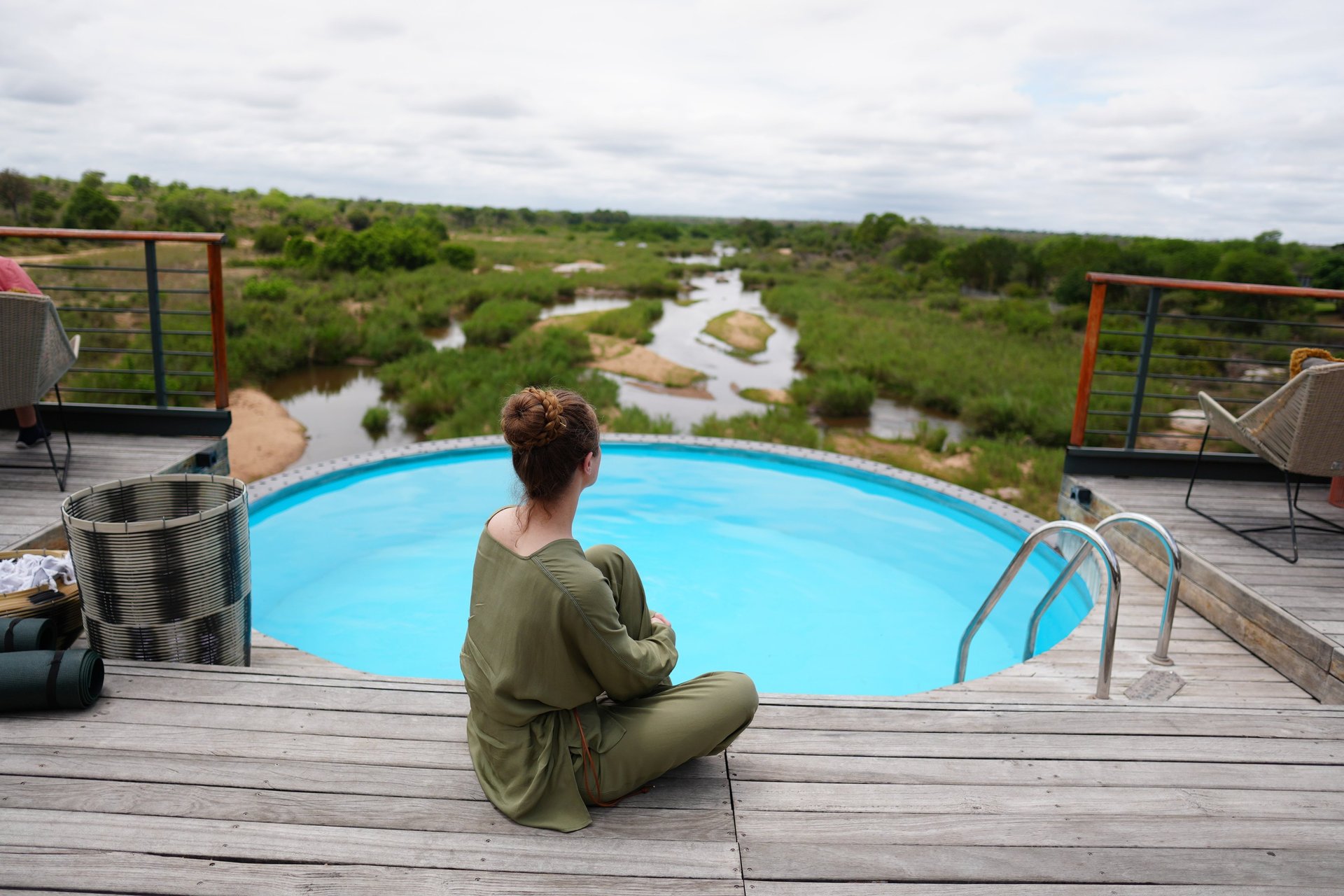
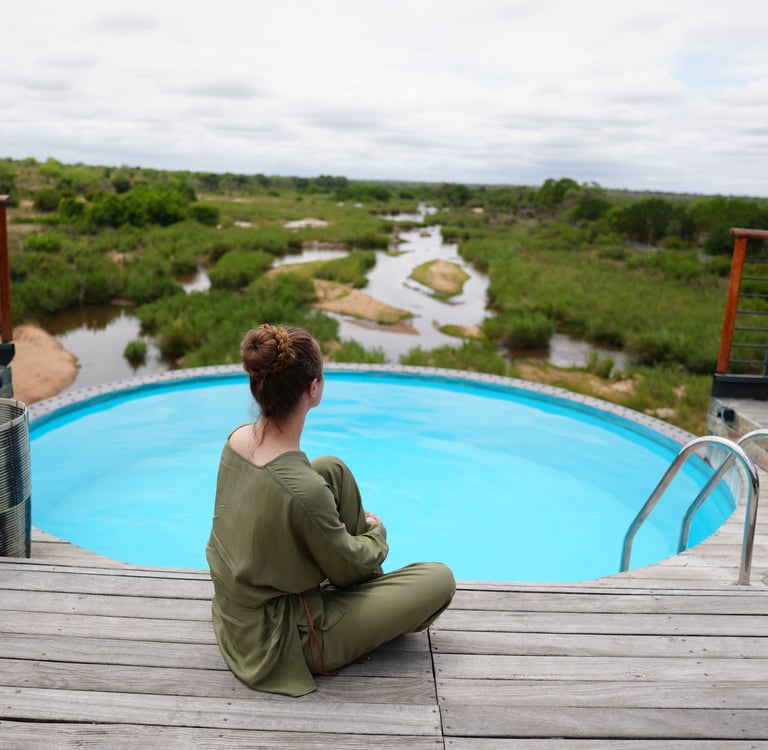
Kruger Shalati was not a happy accident. I researched it, wanted it, planned around it. I had seen the photographs, read everything I could find, and chosen it deliberately, the way you choose something you've been thinking about for a long time.
We were descending into Skukuza on a small Embraer when I saw it. A round pool, impossibly blue against the rust-red bush below. And then the bridge beneath it, and the train on the bridge, and I understood exactly what I was looking at.
I grabbed my husband's arm. He looked. Neither of us said anything.
Knowing something is coming and still being caught off guard by it. That was Kruger Shalati from the first moment.
The hotel was built on a 1912 railway bridge, the Selati Bridge, the same one that carried the first tourist trains into Kruger in the 1920s. For decades the Selati Line ran through the park with as many as 250 trains a week passing through. The animals didn't fare well. Over time the casualties mounted and eventually a decision was made: reroute the line around the western edge of the reserve instead. The last train moved through in September 1973. The bridge stood empty for nearly fifty years, until someone had the idea to put a hotel on it.
The restored carriages don't go anywhere. They sit above the Sabie River by design, each one converted into a suite with large glass walls facing the river, a walk-in shower, a freestanding tub, the kind of room that makes you understand immediately why they book out a year in advance.
We stayed in Bridge House Suite 5, one of seven suites set in the garden adjacent to the bridge. The carriage suites on the train had been our first choice. They were fully booked. We know now that you plan for Kruger Shalati a year in advance, not six months, not three. A year.
But here is the thing about the Bridge House: we were more than satisfied. Our suite looked out over the garden and the bush, and the moment you stepped outside the river was right there. We were slightly closer to the restaurant, which mattered more than we expected at 4am. And the train itself was always in view, glowing at night across the garden, a presence rather than a backdrop. You go to the train for the pool, for the bar, for tea time, for the overhanging deck above the river. You sleep on your side of it, quieter, grounded, with bush and birdsong outside the window. We toured the carriage suites during our stay and they are extraordinary, each one narrow and deliberate and deeply considered. Book them if you can. But don't let availability stop you from going.
It was my birthday. I had known something was being planned. I had seen videos of the staff celebrating guests at other properties across Africa, the whole team involved, song and dancing, the kind of joyful noise that comes from somewhere genuine rather than obligation. I thought I was ready for it. I was not. When they gathered, all of them, and sang, the sound filling the open-air dining space by the bridge, the river below carrying it somewhere I couldn't follow, I felt something loosen in my chest that I hadn't known was tight. My husband was filming. Both cameras, phone too. He wasn't going to miss a frame of it.
Our guide was Victor. Victor is the kind of person who has a name for everything, every bird, every tree, every track in the dust, and he tells you these names the way a person shares something they love rather than something they're paid to know. Warm in the way that people who genuinely enjoy their work are warm. Unhurried. Present.
We went out with him four times. The first two drives were private, just the two of us and Victor and the bush. The third and fourth we shared with a couple from England, Caroline and Tim, who were easy company from the first moment. Caroline had been on safari before, many times, and there is a particular pleasure in being with someone who knows how to be in the bush, who understands the silences, who watches the way Victor watches.
The lions were on the first drive. Victor had gotten word of a kill and we moved quickly through the bush, the vehicle kicking up dust, a specific destination for once rather than a slow scan of the landscape. We came around a bend in the dirt road and he slowed without a word. Two males, stepping across the track directly in front of us, moving from one side of the road to the other with the unhurried confidence of animals who have never once in their lives been prey. They were just finishing a buffalo. We could see it in the ditch, the flies already beginning their work. One of the lions paused. Turned his head. Looked directly at us.
Victor told us later, quietly, what a lion's direct gaze can mean, and why you don't hold it.
Earlier that same day, a leopard. It was lying down in the shade, resting, not performing for us at all. Victor pointed and we looked and there it was, spotted and still and utterly indifferent to our presence. We were lucky, he told us, to see one at all on a first day out. We believed him.
On one of the sundowner drives, he pulled the vehicle to a stop beside a river and the team set out a full spread on the bonnet and fold-out tables: wine, gin with Fever Tree, juice, sparkling water, biltong, small bites from the kitchen. The sun was going down slowly and dramatically, turning the sky colours with no adequate names. Victor pulled out his phone and showed us a video. Taken a few weeks before, same spot. Two lions walking calmly past the vehicle, close enough to touch. Guests pressed back in their seats. Victor telling them, firmly and without alarm, to get inside.
He didn't need to say anything else.
Another morning, we stopped at a dried-up watering hole before breakfast, the land around it cracked and pale and waiting. And then on one of the drives with Caroline and Tim, it rained. Properly, suddenly, the way rain comes in the bush. Victor pulled a tarp and we stayed in the vehicle, all four of us pressed together with our drinks, watching the world go dark and wet around us, laughing in the way you laugh when something goes sideways and turns out to be better than the plan. It was, unexpectedly, one of the best evenings.
The 4am wake-up calls were their own ritual. The phone would ring in the dark, a gentle intrusion, and that was it. Time to go. We would lie there for a moment listening to the river, to whatever was moving through the water below, and then dress quickly and meet Victor at the vehicle. At the breakfast stops they poured Amarula into the coffee, a South African cream liqueur made from the fruit of the marula tree. The tree is called the elephant tree, they told us, because elephants travel for miles when the fruit ripens, drawn to it across the bush. The marula tree is sacred in many local traditions, its fruit used in ceremonies, offerings made beneath it to the ancestors. Drinking Amarula in the bush at first light, with elephants somewhere in the distance, felt less like a detail and more like a small piece of the whole story clicking into place.
The food at Kruger Shalati operates under a philosophy called Kruger to Fork. Everything sourced from the park or the surrounding region, the menu changing with what the land and season offer. It sounds like a concept until you're sitting at a table and the menu itself has your name printed on it. Not a table number. Not a booking reference. Your name.
I have food intolerances. I travel with a list and a degree of resigned anxiety. I am used to the polite confusion, the substitutions, dishes that arrive clearly improvised. At Kruger Shalati the menu had already been adjusted, quietly, without my having to ask again or explain or apologize. Nothing was missing. Nothing was an afterthought.
This is what luxury in the bush looks like. Not the lobby or the thread count. It's the kitchen that read your notes and actually cared. The sommelier who came to the table with South African wine recommendations and spoke about them the way Victor spoke about the bush, with knowledge worn lightly, as if he just wanted you to enjoy the thing.
We ate crocodile. Ostrich. Warthog, which is rich and dark and nothing like you expect, the kind of meat that makes you understand why it was eaten here long before anyone put it on a menu. One evening the hotel brought in local performers, a choir and dancers — Shangaan, we believed, though we never thought to ask and wished afterward that we had. We ate and drank under the open sky trackside, the river sounds all around us. Victor was at the table. We danced too, at some point. We stayed until there was no one left to stay with, knowing full well that 4am was coming and not caring enough to leave.
And then there were the mopane worms.
I want to be honest about the mopane worm. They are a traditional food of the region, a staple in Limpopo Province for generations, protein-rich and deeply local. They are presented on the menu with a kind of quiet pride. And as I looked at the plate I could not stop thinking about a scene from The Lion King, Timon and Pumbaa eating grubs under a waterfall, Simba trying one for the first time. I thought: how different can it really be?
Here is the truth. The outside of a mopane worm is hard. Not crunchy-hard. Hard hard. A rigid exoskeleton that resists the teeth in a way that recalibrates your understanding of the word chew. I chewed what I could. The rest I deposited onto the small plate they had thoughtfully provided for exactly this eventuality. My husband watched this with an expression I recognized as the one he wears when he is trying very hard not to laugh.
I am glad I tried it. I will not be trying it again.
One afternoon at lunch, a herd of elephants wandered through the riverbank below the bridge. We pushed our chairs back and stood at the railing and watched them move through the water, slow and enormous and perfectly unbothered by us. The food went cold. Nobody cared.
The hippos are there all day. You can watch them from the bridge in full daylight, surfacing and submerging in the Sabie River below, occasionally hauling themselves onto a sandbank with the effort of something that has decided gravity is more of a suggestion. There is a particular pleasure in sitting above them with a drink, watching them move through their day with complete indifference to yours.
But the nights on the bridge were something else.
After dark the hippos are louder. A low, resonant grunt that is almost a laugh, almost a groan, the kind of sound that seems to come from deep inside something very old. We lay in the carriage and listened to them below.
And then, at some point in the night, the vervet monkeys arrived on the roof.
Several of them, by the sound of it. Small feet moving quickly, crossing overhead, stopping, starting again. They had no interest in us and considerable interest in the roof. They woke me several times.
Here is the thing: I didn't mind. I lay there, woken by vervet monkeys above and hippos below, in a train carriage suspended over a river in the middle of Kruger National Park, and what I felt was not irritation. It was something closer to gratitude. The kind that arrives quietly and sits down with you.
My husband slept through most of it.
This is what the bush understands about luxury that a great many hotels do not. It is not about what you can see from the room or how the bathroom is appointed. It is about whether you feel taken care of. Truly taken care of, in the way that means your needs were anticipated before you knew you had them. The personalized menu. The phone call at 4am that is both an intrusion and a gift. The sundowner that moves to the vehicle without complaint when it starts to rain, and becomes its own kind of evening. The guide who gives you the information that keeps you safe, and the story that makes the place mean something.
Kruger Shalati is all-inclusive in the way that matters. Not a list of what's covered. A feeling. Exclusive not because it is expensive but because it is private, contained, a world that operates according to its own rhythms and brings you into them rather than bending to yours. Every detail is deliberate. Every gesture lands.
We had dreamed of Africa for years. Not the idea of Africa but the actual thing: the dust and the heat and the sound of something enormous moving below us while we slept. Kruger Shalati gave us that. And it gave us the understanding that when a place really knows what it is doing, you don't have to think about a single thing. You just have to show up.
The bush does the rest.
Kruger Shalati, Train on the Bridge is located in Kruger National Park, Limpopo, South Africa. Skukuza Airport is 4.9km from the hotel. We flew Istanbul to Johannesburg to Skukuza. We stayed in Bridge House Suite 5. The carriage suites on the train book out well over a year in advance. Game drives are arranged through the hotel. Ask for Victor. The Kruger to Fork menu changes with the season. The mopane worms are on there. You'll know what to do.
If this is on your list, let's talk.
This is the kind of trip where the details matter enormously, and the details are exactly what we do. Dietary needs, special occasions, the right room, the right drives, the moments you want anticipated before you even think to ask. We handle all of it, and we work directly with the staff so that by the time you arrive, they already know who you are.
If you'd like help planning your stay at Kruger Shalati, or building a longer South Africa journey around it, we would love to hear from you. Get in touch through the contact form on our website and tell us a little about what you're dreaming of.
We'll take it from there.
We're Passport Dates. Your passport tells a story. Let the world be your ink.
