Dwarika's Hotel Kathmandu: The Stillness We Were Looking For
We arrived in Kathmandu with different needs: my husband wanted rest, I wanted more. Dwarika's Hotel gave us both. A stay inside rescued Newari architecture, a temple ceremony led by a stranger who became a guide, and a courtyard musician who played for the birds while we forgot to reach for our phones.
NEPALKATHMANDUINTENTIONAL TRAVELSLOW TRAVELHERITAGE TRAVELDWARIKA HOTELASIACOUPLES TRAVEL
Elaine Brackin
6/19/20269 min read

I had been in Egypt the week before. Before that, somewhere else entirely. My husband, who is a patient man, a musician, someone who understands that rest is not the absence of living but the condition for it, had been quietly hoping for calm. I had been quietly hoping for more. We have been married long enough to know this about each other, and to love each other anyway.
Kathmandu gave us both what we needed. That's the thing I keep trying to explain and keep failing to, because it sounds like a travel brochure and it wasn't. It was more complicated and more true than that. The city is chaos and stillness at once: motorbikes and incense, shrines wedged into every available corner, children playing in the streets of the hills while their parents garden the terraces above. I watched those people and thought: they have almost nothing by the measure of the world I come from, and they seem more at ease in their lives than most people I know.
That observation will keep returning to me. It is the thing Kathmandu gave me that I didn't know to ask for.
A Building That Refused to Disappear
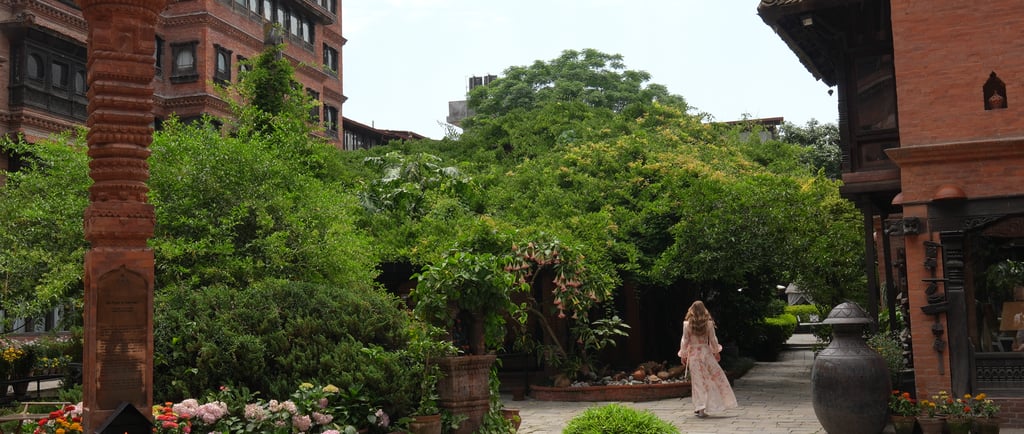
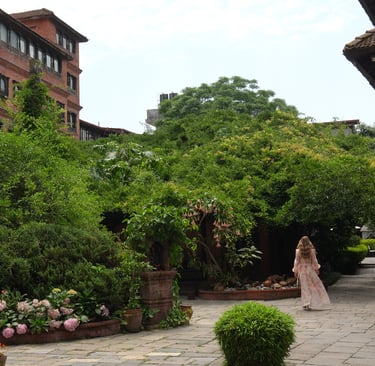
The taxi stops. A guard in traditional dress pushes the gate wide and we catch a glimpse of what's on the other side: carved columns, a courtyard so still it seems to belong to a different century. The noise of the street simply stops. Not fades. Stops.
This is how Dwarika's begins.
In 1952, a Nepali man named Dwarika Das Shrestha was out jogging when he came upon carpenters sawing off the carved portion of an intricately engraved wooden pillar, centuries-old woodwork being carted off as firewood. It stopped him. He began collecting what was being lost: the hand-carved Newari architecture of the Kathmandu Valley, windows and pillars and doorframes worked into intricate figures over centuries, disappearing into a world moving too fast to grieve what it was losing. He spent decades at it, rescuing beams and columns from buildings being demolished, from sellers who had stopped seeing the value in what they held. In 1977 he registered a hotel around what he had saved.
What moves you is not the preservation. It's the stubbornness of it. The refusal to accept that beautiful things must be lost simply because no one is paying attention.
His wife, Ambica, carried the legacy after his death in 1992, taking on roles unusual for women in Nepal at the time, running the property, holding the vision intact, earning a reputation as one of Nepal's most pioneering women entrepreneurs. I thought about what it meant to be her: in rooms full of men, in a city where many women still occupy primarily domestic roles, making decisions, protecting something that mattered. Women like her make such a difference, and rarely get the credit they deserve. Their family still lives on the property. You feel that: the particular quality of a place loved by the people who built it.
The City at the Gate
Outside the hotel's walls, Kathmandu is entirely itself.
Motorcycles negotiate with pedestrians in a language that has no written form but somehow works. Shrines appear mid-wall, in doorway crooks, wherever a god seemed to want a home. The air smells of diesel and marigolds and spices and something frying in ghee. It is not a city that apologizes for itself.
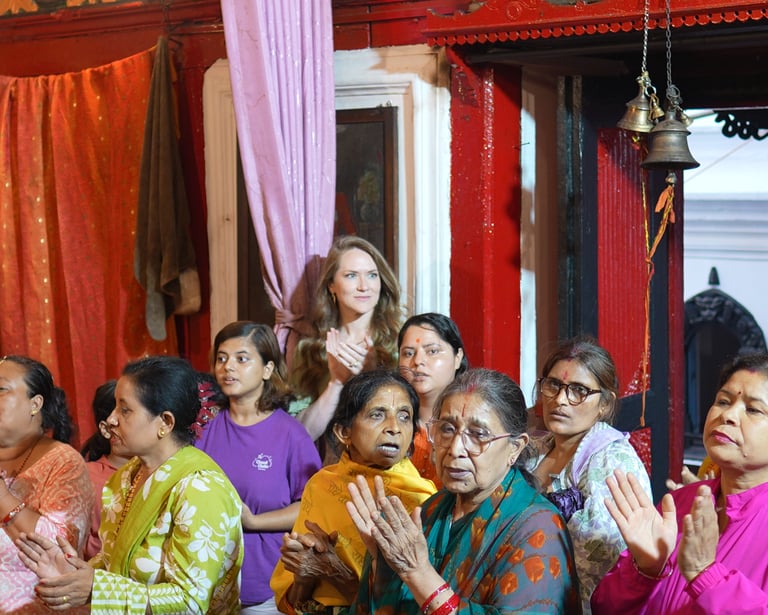
We walked to a 150-year-old temple for the evening Aarti with a guide from the hotel, a complimentary service offered quietly and without fanfare. He carried a basket of offerings. As we stepped out, I noticed the rain-slicked streets and asked whether we should take an umbrella.
"If you need one," he said, "someone will bring it from the hotel."
He said it the way you'd say something obvious. We did not need to carry anything.
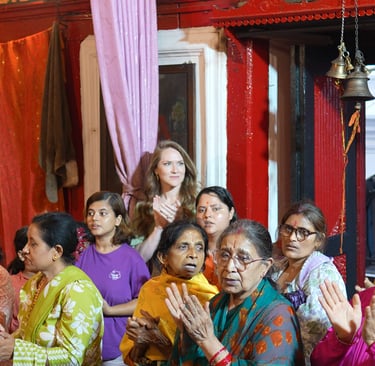
I had wanted to melt into the background at the temple. I was a little afraid of intruding, of being the tourist who makes a sacred space feel like a destination. But a young local woman found me near the entrance and simply took me under her wing. She walked me through each step: where to stand, when to move, what each part of the ceremony meant. She made me feel so welcome, like I could observe and participate and belong without guilt, like my presence wasn't an imposition but was somehow, improbably, fine.
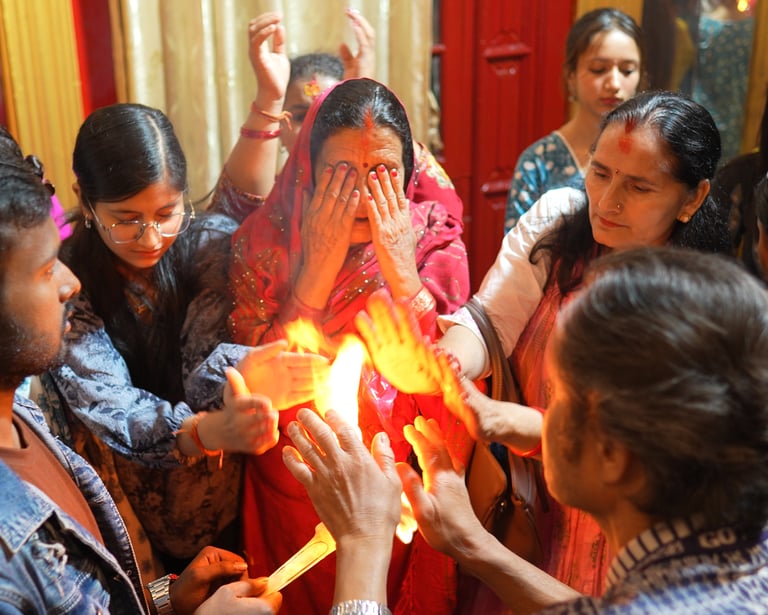
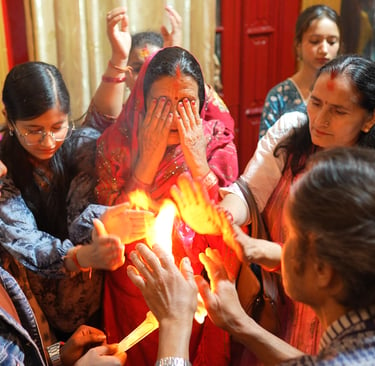
The priest moved a flame in front of the gods. Water was poured into our hands, then sugar crystals. The shoes of the gods, small and ceremonial, were pressed gently to our foreheads. Something yellow and damp. The people around us raised their hands and chanted, and I raised mine too, not because I knew what I was doing but because it seemed like the right response to something I didn't fully understand, which is often the only honest one.
At the end, our offering was returned to us from the gods. We ate it. We were led to a courtyard where a man read us the story of Ram over masala chai and lakhamari, and the rain didn't come.
I don't have a word for what it felt like to be included in something that old and that real. Welcome is too small. It was more like: recognized.
The Afternoon the Music Arrived
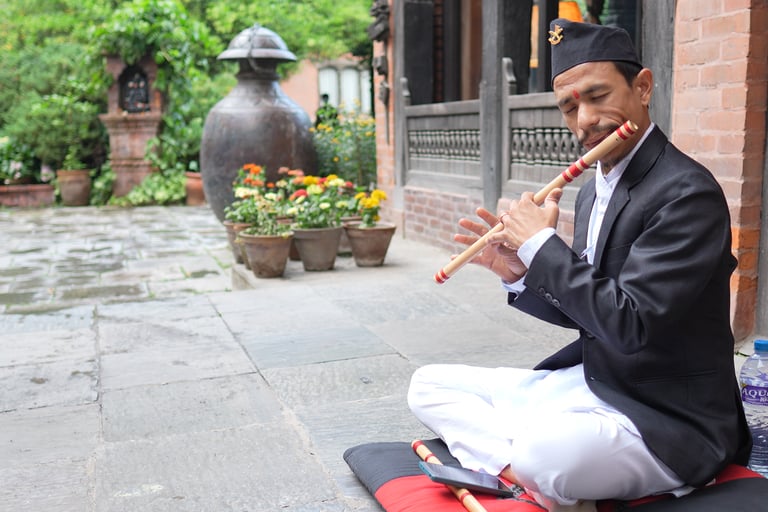
We were in the courtyard waiting for our guide, just before we left for the temple, when a man crossed the garden, spread a traditional blanket on the ground, and sat down cross-legged. He took out an instrument, something like a flute, and began to play.
The birds answered him. The garden birds, the ones that had been doing whatever birds do in carved Nepali courtyards in the late afternoon: they wove in and out of what he was playing in a way that seemed, absurdly, intentional.
My husband and I are both musicians. We know what it sounds like when someone plays for the playing, when the performance is not directed outward but is simply the thing itself. This man played as though being listened to made no difference to him at all. There was a peace in it I recognized, and underneath the peace something that felt like excitement, not the kind that needs to go anywhere, but the kind that comes from realizing you are exactly where you should be.
Neither of us spoke. Neither of us reached for a phone.
Later, when the performance was still going, we did take a video. I'm glad we did. But in that first unguarded moment, we just listened. The world kept playing and we stayed inside it, still.
Tigers and Goats
Every room at Dwarika's has one: a Bagh Chal set, cast in golden metal, sitting on the table like a quiet invitation. Bagh Chal means "tigers move," a traditional Nepali game played on a 5x5 grid for more than a thousand years. Four tigers against twenty goats. Tigers capture goats by jumping over them, needing to take five to win. The goats win by surrounding all four tigers until none can move. It sounds simple. It is not simple.
We film a lot of our travels: it's part of what we do, part of how we share, and sometimes we'll do something partly for the camera. We know this about ourselves and mostly make peace with it. But the Bagh Chal game we played for no one. Just us and the carved table and the city outside the window and three rounds that my husband refuses to fully account for.
The goats won twice. We had a good laugh. It was exactly enough.
The Man at Breakfast
He was there when we arrived for breakfast one morning, dressed head to toe in yellow and khaki, the kind of considered outfit that takes thought to appear effortless. On the table beside his coffee sat a leather writing pouch, soft with use, stuffed with notebooks and pens and a small paperback. He was writing something by hand, unhurried, occasionally looking up at the garden the way a person looks at something they have already decided to remember.
We didn't speak that morning. We didn't need to. He was company in the way that only strangers in beautiful places can be, his presence a kind of permission to slow down.
Later, he found us elsewhere on the property and said something to my husband: something about having a camera and, whenever you wanted, a beautiful subject ready to be captured. It was gracious and exact and a little old-fashioned in the best possible way.
It made me wish for times since gone. Times when people moved through the world with less urgency. When a leather pouch of notebooks was enough to carry. When a morning at breakfast was something you stayed for.
He never touched his phone. Not once that we saw.
The Room Itself
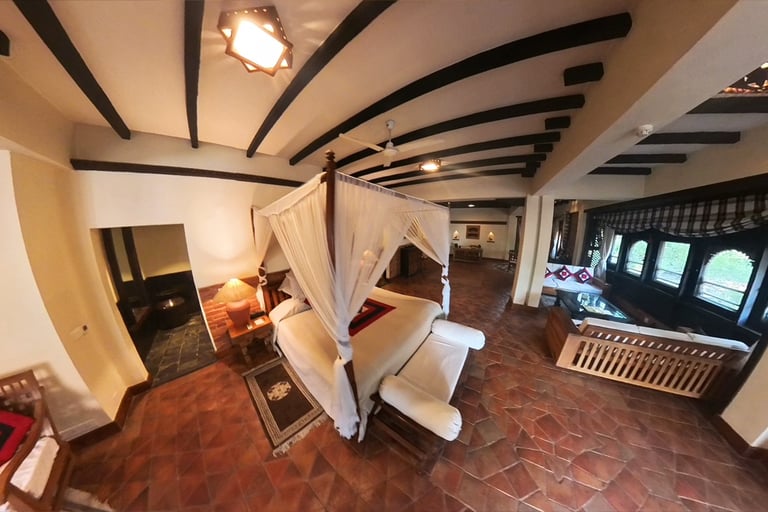
The rooms at Dwarika's are not decorated. They are composed, each element placed with an intention you feel before you can articulate it. The carved woodwork continues from the public spaces into the private ones. The tub is wide and deep and worth running slowly. The amenities are handmade: you know it by the weight of the soap, by the way it smells like something a person made rather than something a factory approximated.
We lingered in that room more than we usually do. We played Bagh Chal. We read. We watched the light shift on the courtyard from the window without needing to photograph it. The hotel has a gift for removing the sense of hurry without you noticing it's gone.
Outside the bar, photographs of musicians covered the walls: portraits of performers, faces caught mid-song, an archive of sound in a room that remembered it. We had drinks by the pool, where small stone spouts fed water in a continuous, gentle stream, and sat with our thoughts and each other in the way that's only possible when neither of you is needed somewhere else.
You can have as much privacy as you want at Dwarika's. Everyone there is quietly, thoughtfully minding their own experience. You feel alone in the best possible way, and still connected: to the place, to your person, to the low hum of a city carrying on beautifully outside the gate.
What We Were Looking For
On one of our last mornings we watched the people in the hills above the city: gardening the terraces, children playing in the streets, the ordinary unhurried texture of a life lived at a different pace. Nepal's average monthly salary is around $150. By every economic measure, these were not people with much. And yet I kept thinking: they seem more at ease than almost anyone I know.
My husband and I have been craving a slower life. We say this and then we book another trip, which is either a contradiction or a search for evidence, proof that the thing we're craving is real and somewhere findable, not just a feeling we keep almost touching. Kathmandu was the closest we've come.
The stillness and the chaos both. The old and the new pressed up against each other without apology. A musician in a courtyard who played for the birds. A woman in a temple who made a stranger feel welcome. A hotel that spent decades refusing to let beautiful things disappear.
We don't know yet how to bring that pace home. But we know now, more clearly than before, what we're looking for.
The Practical Magic
Getting there: Kathmandu's Tribhuvan International Airport is a short taxi ride from the hotel. The hotel can arrange transfers, or you can use a taxi with either In-Drive, Uber (newer with some difficulties still), Pathao and Yango.
Rates: Dwarika's is a Heritage Hotel. Rates vary by season and room type, approximately $250 to $500 per night for the base rooms.
Using points to offset the cost: We used our Capital One Venture miles for this trip — transferred to Turkish Airlines, which is how we got to Kathmandu. The transfer partners are quietly one of the card's best features. It also earns 2x miles on every purchase and 10x on hotels booked through Capital One Travel. For anything you don't transfer, miles redeem at 1 cent each directly against travel charges on your statement. The card earns while you're living your life, and pays for the part that matters most. Apply for the Capital One Venture here (affiliate link, no extra cost to you)
How long to stay: Three nights minimum. Two to settle in, one to realize you should have booked five.
What to do: Say yes to the complimentary guided temple walk. Take nothing. Arrive with open hands. Play Bagh Chal in your room before dinner. Sit in the courtyard in the afternoon and wait for whatever the afternoon decides to offer.
Book with me: I'm a travel advisor and I design Nepal itineraries regularly. If you want help building a trip around Dwarika's, reach out here. Hotel-only bookings are complimentary.. For full itinerary design, we'll talk through what that looks like together.
If you're self planning and adding day tours or experiences: Viator is where I send clients for well-reviewed, bookable tours in Kathmandu and beyond. Temple walks, valley day trips, Everest flights, it's all there.
Travel insurance: Nepal is remote. Please insure your trip. I use and recommend Faye, it's the one I buy for myself.
Some links in this post are affiliate links. If you apply for the Capital One Venture , book a tour through Viator, or get a quote through Faye, I may earn a small commission at no extra cost to you. I only recommend what I personally use.